


インドネシアダイビング情報: Indonesia Diving Information
 およそ18,000の島々から成るインドネシアは、陸も海も秘境という名にふさわしい神秘的な国です。最近はアクセスが便利になり、日本から訪れやすくなりましたが日本からの直行便が飛ぶのはジャカルタとバリだけでほとんどのエリアに行くには国内線による東西移動が必要です。赤道を挟んで約3000kmに渡り、島々が点在する島嶼国で無数のダイビングエリアが広がります。太平洋とインド洋に面しており、また有名なウォーレス線で2分されているので、生物多様性の宝庫といわれ、固有種が混在する海は圧巻です。 人気のリゾートであるバリをはじめ、マクロ生物の宝庫、レンベ・メナド、アンボン、手つかずの海が広がるワカトビ、回遊魚が回る秘境・ラジャアンパッド、コモドドラゴンで有名な「世界自然遺産」コモドなど、多彩なダイビングサイトが存在します。赤道直下にあるため台風の影響もなく通年潜ることができます。リゾートから離れたエリアを季節ごとの異なったルートで周遊するリヴアボードが100隻近くあり、どれも多様なコース取りが季節別に行われており、リピーターでにぎわっています。どこに行くにも移動時間が長いので長期でのツアーがお薦めです。
Comprising approximately 18,000 islands, Indonesia is a mysterious country that truly lives up to its reputation as a land of uncharted wonders, both on land and at sea. While access has become more convenient recently, making it easier to visit from Japan, direct flights from Japan are available only to Jakarta and Bali; to reach most other areas, you’ll need to take domestic flights to travel from east to west. Spanning approximately 3,000 km across the equator, this archipelago is dotted with islands and boasts countless diving sites. Bordered by the Pacific and Indian Oceans and divided by the famous Wallace Line, it is considered a treasure trove of biodiversity, and its waters—teeming with endemic species—are truly breathtaking. There is a diverse array of dive sites, including the popular resort of Bali; Lembeh, Manado, and Ambon—treasure troves of macro life; Wakatobi, with its pristine waters; Raja Ampat, a remote paradise teeming with migratory fish; and Komodo, a “World Natural Heritage Site” famous for its Komodo dragons. Because it lies directly on the equator, the region is unaffected by typhoons, allowing for year-round diving. There are nearly 100 liveaboards that cruise through areas away from the resorts on routes that vary by season; each offers diverse itineraries tailored to the season and is popular with repeat visitors. Since travel times are long no matter where you go, long-term tours are recommended.
Translated with DeepL.com (free version)
□traveltip:ASEAN諸国でインドネシアのみ入国ビザが必要です。オンライン申請で5000円ほどでクレジットカード決済ができます。  ウォーレシア(ワラセア) Wallacea
 The epicenter of biodiversity.
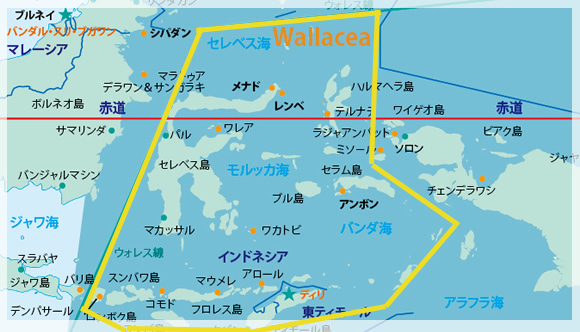
19世紀に活躍していたイギリス人の生物学者、探検家にアルフレッド・ラッセル・ウォレスにちなんで 深い海峡によってアジアともオーストラリア大陸の大陸棚とも隔てられたインドネシアの島嶼の一群をウォーレシア(ワラセア)と呼んでいます。 ジャワ島、バリ島、ボルネオ島より東側と、ニューギニアと東ティモールの西側にあるインドネシア中心部の島々の 生物地理学的な区分です。バリ島とロンボク島はこのウォーレス線にて2分され、互いの島が見えるほどの距離なのに異なった生態系を呈しています。バリのビーチは黒砂なのに対して同じく火山島であるロンボク島にはホワイトサンドビーチが広がっています。 ウォーレシアは深い海峡によってアジア(スンダランド)ともオーストラリア大陸(サフールランド)とも隔てられており 長い歴史の中で大陸とつながったことが一度もない島です。ネコ科のトラやライオン等の強大な捕食者がいないため弱肉強食とは無縁だったことが 他の地域とは違った進化をもたらしました。独特の進化を遂げたコモドドラゴン、クロザル、バビルサなどの動物たちが森の中に今も暮らしています。
A group of Indonesian islands, separated from both Asia and the Australian continental shelf by deep straits, is called Wallacea (or Warasea), named after the 19th-century British biologist and explorer Alfred Russel Wallace. It is a biogeographic region comprising the islands in central Indonesia—located east of Java, Bali, and Borneo, and west of New Guinea and East Timor. Bali and Lombok are divided by the Wallace Line; although the two islands are close enough to see each other, they exhibit distinct ecosystems. While Bali’s beaches feature black sand, Lombok—also a volcanic island—boasts expansive white-sand beaches. Wallesia is separated from both Asia (Sundaland) and the Australian continent (Sahurland) by deep straits and has never been connected to a mainland throughout its long history. The absence of powerful predators such as tigers and lions—members of the cat family—meant that the “survival of the fittest” principle did not apply here, leading to an evolutionary path distinct from other regions. Animals that have undergone unique evolution, such as the Komodo dragon, the black langur, and the babirusa, still inhabit the forests today.
